

RegualtingAI’s Sanjay Puri and Club de Madrid Lead Global Call for Democratic AI Governance Ahead of UN Summit

RegulatingAI Podcast
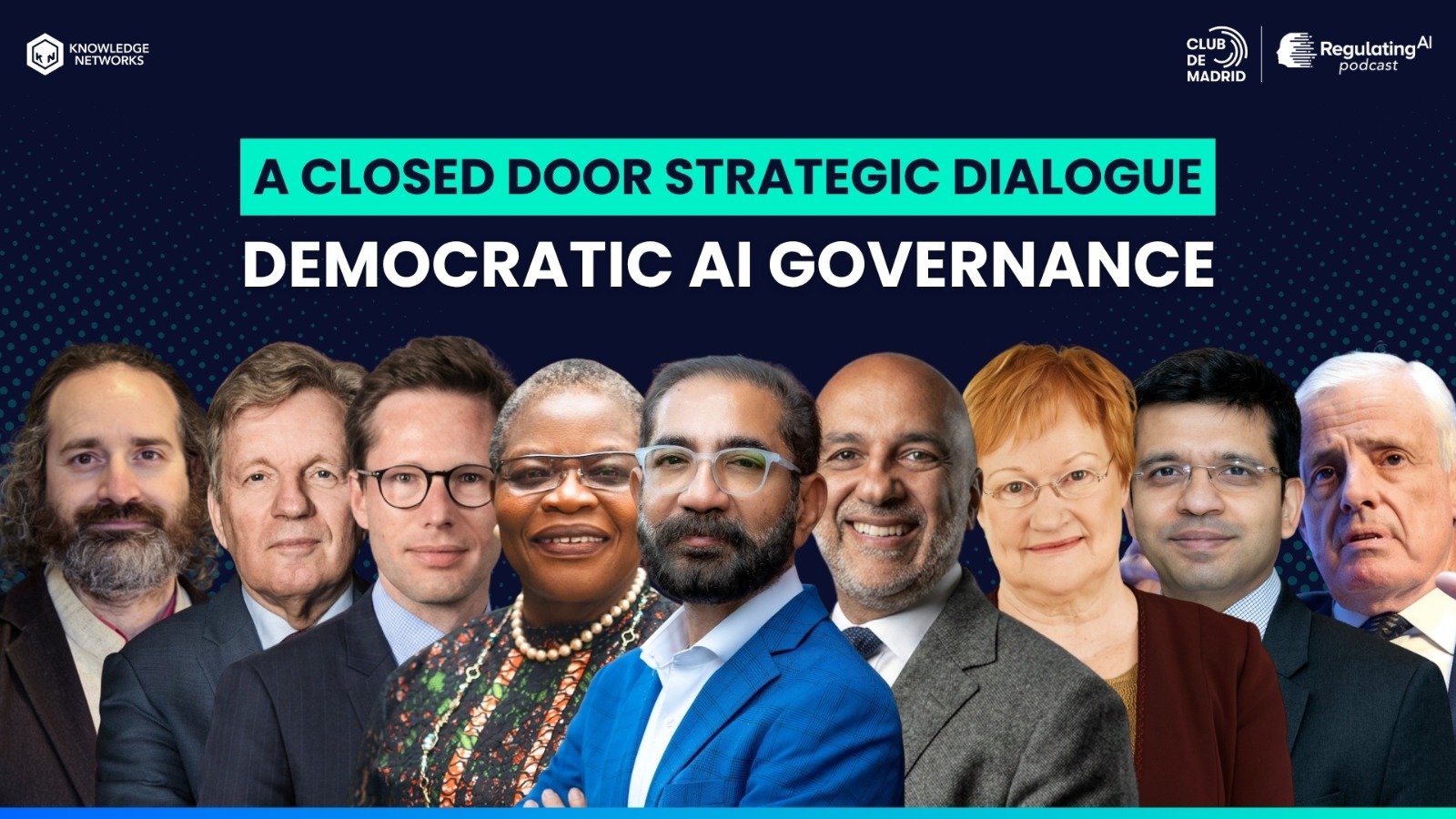
Sanjay Puri, President of RegulatingAI with the panel of Club de Madrid
Global leaders at RegulatingAI and Club de Madrid urged democratic AI governance, inclusion, accountability, and global cooperation ahead of the UN AI summit.
Opening the session, Puri emphasized the urgency of creating governance frameworks capable of keeping pace with AI’s rapid evolution. While AI is projected to contribute $15.7 trillion to the global economy by 2030, he argued that economic opportunity without governance could create significant societal risks. The discussion was strategically timed ahead of the inaugural UN Global Dialogue on AI Governance, scheduled for July 6–7, 2026, in Geneva, with conclusions from the session set to be submitted directly to UN leadership for consideration.
In his keynote address, Priam Maluor highlighted the extraordinary speed of AI adoption, noting that ChatGPT reached 100 million users in just two months, compared to seven years for the internet. He stressed that AI is no longer merely a technological innovation but a foundational force reshaping economies, healthcare, education, labor markets, and governance systems. Maluor also pointed to a growing global AI divide, where advanced AI capabilities remain concentrated in a handful of countries while many developing nations lack access to computing infrastructure, data resources, and skilled talent. According to him, AI governance must therefore focus not only on regulation but also on inclusion, access, and capacity building.
A central theme throughout the discussion was ensuring that the benefits of AI are distributed equitably. Former Nigerian minister Obiageli Ezekwesili highlighted AI’s transformative potential for Africa, citing projections that AI could inject trillions into the continent’s economy and create millions of jobs. However, she warned that without investments in education, digital infrastructure, and skills development, Africa risks becoming merely a consumer of AI technologies developed elsewhere. Echoing this concern, Esko Aho argued that smaller countries and developing economies can still benefit significantly from AI if they focus on integrating the technology into key sectors such as healthcare, education, and public services.
The panel also examined the challenge of fragmented global AI governance. While countries around the world are developing their own regulatory frameworks—from the European Union’s AI Act to governance models emerging across Asia, Africa, and the Americas—participants questioned whether a unified global framework is achievable. Former President Tarja Halonen advocated for a practical, sector-based approach involving governments, industry, civil society, and international organizations. Ezekwesili proposed a two-layered governance model that combines national flexibility with a minimum set of global principles, ensuring broader participation beyond the world’s largest AI powers.
Accountability emerged as another critical concern as AI systems become increasingly autonomous. Dr. Micky Tripathi and Sean Cleary explored the complexities of determining responsibility when AI-driven decisions cause harm. Cleary argued that future governance frameworks must establish clear purposes for AI systems, define enforceable ethical norms, and create mechanisms for continuous oversight before deployment. Participants agreed that meaningful transparency, human oversight, and international cooperation are essential to maintaining public trust as AI capabilities continue to advance.
Closing the session, Puri noted a growing consensus among participants that the real choice facing societies is not between innovation and regulation, but between “governed innovation and ungoverned risk.” With the UN Global Dialogue on AI Governance and the AI for Good Global Summit approaching in Geneva, the discussion underscored the need for urgent international collaboration. As AI increasingly shapes every aspect of society, leaders agreed that democratic governance, shared accountability, and global cooperation will be critical to ensuring that the technology serves humanity’s broader interests rather than deepening existing inequalities.
Upasana Das
Knowledge Networks
email us here
Visit us on social media:
LinkedIn
Instagram
Facebook
YouTube
X
Legal Disclaimer:
EIN Presswire provides this news content "as is" without warranty of any kind. We do not accept any responsibility or liability for the accuracy, content, images, videos, licenses, completeness, legality, or reliability of the information contained in this article. If you have any complaints or copyright issues related to this article, kindly contact the author above.
