

Global Medical Device Semiconductor Market to Reach $9.8 Billion Driven by Connected Care Demand in US and Europe
Medical Device Semiconductor Market Size, Volume, Price Trends, Competitive Landscape
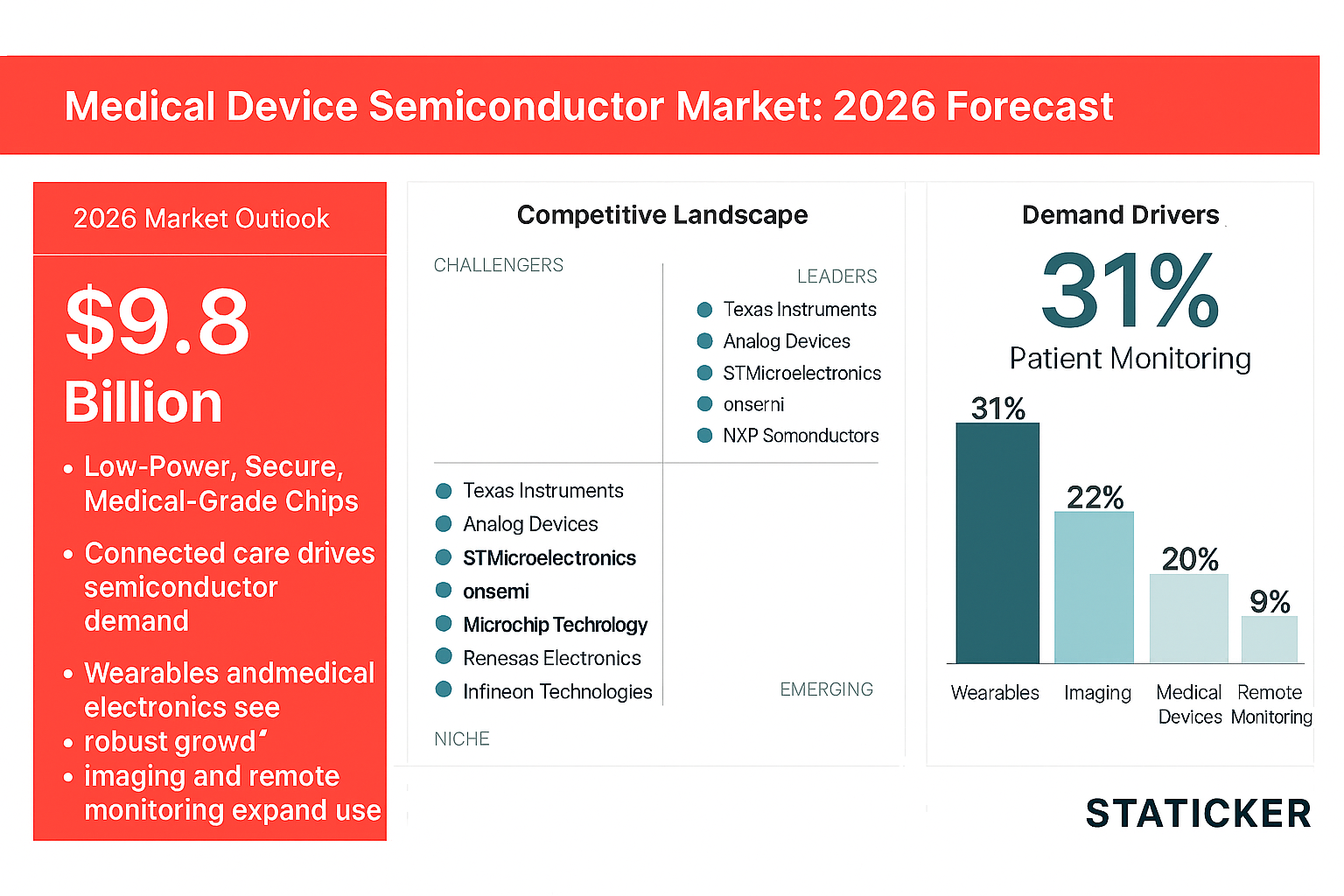
Global medical device chip market to hit $9.8B by end of 2026 as US and Europe connected care and wearable remote monitoring demands surge.
NEW DELHI, INDIA, June 10, 2026 /EINPresswire.com/ -- The medical device semiconductors market is projected to reach USD 9.8 billion in 2026, according to Staticker, as healthcare OEMs expand the use of chips in connected monitors, portable diagnostics, imaging systems, and battery-powered therapeutic devices. The trend aligns with broader digital health adoption, including remote care, wearable monitoring, and software-enabled diagnostics, as highlighted by the U.S. Food and Drug Administration’s Digital Health Center of Excellence and ongoing cybersecurity guidance for medical devices.
The market is being shaped by the rapid adoption of connected medical devices, remote patient monitoring, wireless diagnostics, and low-power digital health platforms. As hospitals and device makers prioritize longer battery life, secure data transmission, and compact designs, demand is rising for medical-grade semiconductors with enhanced reliability, safety, and lifecycle support. The shift is consistent with the World Health Organization’s emphasis on medical devices as a core component of modern healthcare delivery.
Connected Care Drives Semiconductor Integration in Medical Devices
In 2025 and 2026, semiconductor demand in healthcare is increasingly tied to connected care, wearable devices, sensor-based monitoring, and cybersecurity requirements. Medical OEMs are integrating more chip functions into each device to support biosignal sensing, signal conditioning, edge processing, wireless connectivity, memory, battery management, and secure communication. FDA cybersecurity expectations for connected medical devices are also encouraging more secure chip architectures and validated software-hardware integration.
A connected wearable or remote-monitoring device typically relies on multiple semiconductor functions, making healthcare a higher-value design-in market. Demand is rising fastest in wearable health monitors, remote patient monitoring devices, portable diagnostics, and imaging equipment.
The broader medical electronics market is also expanding, supported by hospital digitization, home-based care, and portable equipment adoption.
Patient Monitoring and Wearables Hold the Largest Share
Within the medical device semiconductors market, patient monitoring, wearables, and remote diagnostics are expected to account for the largest share in 2026, representing an estimated 31% of total demand.
Diagnostic imaging follows with 22%, while therapeutic and infusion devices contribute 18%. Portable diagnostic systems account for 16%, and surgical, implantable, and specialty devices make up the remaining 13%.
This mix reflects the shift toward continuous care, where devices must collect, process, and transmit health data with low power consumption and high reliability. Wearable ECG patches, glucose monitors, pulse oximeters, smart inhalers, and connected vital-sign monitors are increasing demand for low-power microcontrollers, analog front-end ICs, sensor chips, RF connectivity chips, and power management ICs.
Analog, Power Management, and Sensor Chips Dominate Product Demand
By product type, analog and mixed-signal semiconductors are expected to hold the largest share of the medical device semiconductors market in 2026 at 33%.
Other major product categories include:
Microcontrollers and embedded processors: 20%
Power management ICs: 18%
Sensors and biosensing ICs: 15%
Memory, logic, ASICs, FPGAs, and AI accelerator chips: 8%
Connectivity and RF chips: 6%
Analog chips support biosignal capture and signal conditioning. Power management ICs help control battery life and voltage stability in portable systems. Microcontrollers manage device control logic, while sensor ICs support pressure, optical, motion, temperature, and biosignal measurement.
AI-Enabled Chips Gain Traction in Premium Medical Devices
AI-enabled semiconductors are expected to account for 12% to 16% of semiconductor content in medical devices by 2030, according to DataVagyanik Business Intelligence, as OEMs embed edge intelligence into imaging, diagnostics, monitoring, and selected therapeutic systems. This trend mirrors growing interest in edge AI across regulated healthcare electronics, a segment increasingly discussed in industry and research communities such as IEEE.
Diagnostic imaging is projected to remain the largest AI-related semiconductor category, accounting for 35% to 40% of AI-related chip demand by 2030. Remote monitoring and wearables are expected to contribute 25% to 30%, supported by local biosignal analysis, alarm reduction, and battery-efficient analytics.
Portable diagnostics may account for 15% to 20%, while surgical and therapeutic systems are projected to represent 10% to 12% as workflow automation and precision control expand.
Diagnostic Imaging Remains a High-Value Application
Diagnostic imaging remains one of the most semiconductor-intensive segments in the medical device semiconductors market, accounting for an estimated 22% of market value in 2026.
MRI, CT, ultrasound, X-ray, and fluoroscopy systems require semiconductors for image capture, signal conversion, control logic, image reconstruction, power regulation, and display management. Growth is supported by hospital modernization and the rising use of software-driven imaging platforms.
Portable ultrasound is emerging as a major growth opportunity because it combines mobility with high electronics content, increasing demand for low-power processors, sensor interfaces, wireless chips, and compact power architectures.
Competitive Landscape Includes Major Analog, MCU, and Connectivity Suppliers
The medical device semiconductors market is served by analog, power management, microcontroller, sensor, and connectivity chip suppliers. Competition is shaped by low-power performance, medical-grade reliability, long product availability, regulatory support, secure connectivity, and design-in assistance for healthcare OEMs.
Key suppliers include:
Texas Instruments
Analog Devices
STMicroelectronics
onsemi
NXP Semiconductors
Microchip Technology
Renesas Electronics
Infineon Technologies
ROHM Semiconductor
ams OSRAM
TE Connectivity
Sensirion
Honeywell
Qualcomm
Broadcom
Nordic Semiconductor
Silicon Labs
These companies compete across analog, microcontrollers, power management, sensors, and low-power wireless connectivity used in patient monitors, diagnostic equipment, wearable devices, and portable therapeutic systems.
Market Outlook
As healthcare shifts toward connected care, home monitoring, and energy-efficient medical electronics, semiconductor content per device is expected to increase. More devices now require secure connectivity, biosensing, processing, and power optimization in a single platform, supporting steady growth in the medical device semiconductors market through 2026 and beyond.
Browse Adjacent Markets in the Medical Device Semiconductor Ecosystem
*Medical Sensors Market Size, Sales Volume, Price*
Peter Dev
Staticker
Peter@staticker.com
Visit us on social media:
LinkedIn
Legal Disclaimer:
EIN Presswire provides this news content "as is" without warranty of any kind. We do not accept any responsibility or liability for the accuracy, content, images, videos, licenses, completeness, legality, or reliability of the information contained in this article. If you have any complaints or copyright issues related to this article, kindly contact the author above.
