

Enteral Feeding Devices Market Size to Reach $ 3.58 Billion by 2034, Driven by Chronic Disease Management
Enteral Feeding Devices Market
Enteral Feeding Devices Market Size, Share & Industry Analysis, By Product, By Age Group, By Application, By End User, and Regional Forecast, 2026-2034
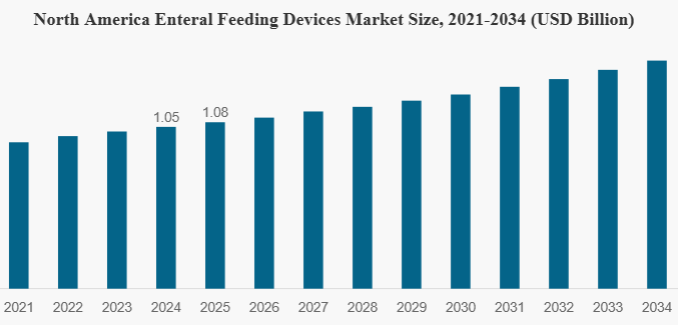
North America held the dominant share in 2024, valued at USD 1.05 billion, and also took the leading share in 2025 with USD 1.08 billion.”
PUNE, MAHARSHTRA, INDIA, February 7, 2026 /EINPresswire.com/ -- The global Enteral Feeding Devices Market is witnessing steady growth as healthcare systems increasingly focus on long-term nutritional support for patients unable to meet dietary requirements through oral intake. The market size was valued at USD 2.47 billion in 2025 and is projected to grow from USD 2.54 billion in 2026 to USD 3.58 billion by 2034, exhibiting a compound annual growth rate (CAGR) of 4.4% during the forecast period. This growth reflects the rising prevalence of chronic diseases, expanding geriatric population, and growing shift toward home-based nutritional care.— Fortunebusinessinsights.com
Enteral feeding devices are used to deliver nutrition directly into the gastrointestinal tract via tubes or pumps, supporting patients with swallowing difficulties, neurological impairments, cancer, gastrointestinal disorders, and critical illnesses. These devices play a crucial role in maintaining adequate nutrition, improving clinical outcomes, and reducing hospital length of stay, making them an integral part of modern healthcare delivery.
Get a Free Sample Research Report: https://www.fortunebusinessinsights.com/enquiry/request-sample-pdf/enteral-feeding-device-market-112053
Market Drivers: Chronic Diseases and Aging Population
One of the key drivers of the enteral feeding devices market is the increasing burden of chronic and lifestyle-related diseases worldwide. Conditions such as cancer, stroke, Parkinson’s disease, diabetes, and gastrointestinal disorders often impair patients’ ability to consume food orally, necessitating enteral nutrition support. As the global incidence of these conditions continues to rise, demand for reliable and safe enteral feeding devices is expanding.
The growing elderly population further supports market growth. Older adults are more susceptible to malnutrition due to age-related physiological changes, reduced appetite, and higher prevalence of chronic illnesses. Enteral feeding devices are widely used in long-term care facilities, hospitals, and homecare settings to ensure consistent nutritional intake among geriatric patients.
In addition, increasing survival rates among critically ill patients and premature infants are contributing to higher adoption of enteral feeding solutions, particularly in intensive care units and neonatal care environments.
Technological Advancements and Product Innovation
Technological innovation is playing a vital role in shaping the enteral feeding devices market. Manufacturers are focusing on developing devices with improved safety features, ease of use, and enhanced patient comfort. Enteral feeding pumps with programmable flow rates, alarms, and connectivity features are increasingly being adopted to reduce the risk of overfeeding, underfeeding, and tube-related complications.
Advancements in tube materials and designs are also improving patient outcomes. Soft, biocompatible materials and low-profile gastrostomy and jejunostomy tubes enhance comfort and reduce the risk of irritation or infection. These innovations are particularly important for patients requiring long-term enteral nutrition.
Expanding Shift Toward Homecare Settings
A significant trend influencing the enteral feeding devices market is the shift toward home-based care. Healthcare systems are increasingly encouraging early discharge and outpatient management to reduce costs and improve patient quality of life. Enteral feeding devices designed for homecare use are gaining popularity due to their portability, user-friendly interfaces, and compatibility with long-term nutritional regimens.
Home enteral nutrition allows patients to receive continuous care in familiar environments while reducing hospital-associated complications. As patient education and caregiver training improve, adoption of enteral feeding devices in homecare settings is expected to rise steadily over the forecast period.
Market Segmentation Overview
The enteral feeding devices market is segmented by product, age group, application, end user, and region, reflecting its broad clinical utility.
By product, the market includes instruments, enteral feeding tubes, nasogastric tubes, gastrostomy tubes, jejunostomy tubes, enteral feeding pumps, and accessories. Enteral feeding tubes and pumps represent a significant share due to their widespread use in both acute and long-term care.
By age group, the market is divided into adults and pediatrics. Adult patients account for the largest share, driven by high prevalence of chronic diseases, while the pediatric segment continues to grow due to advancements in neonatal and pediatric care.
By application, major segments include oncology, neurological disorders, gastrointestinal disorders, diabetes, and others. Oncology and neurological disorders represent key application areas due to prolonged nutritional support requirements.
By end user, hospitals and ambulatory surgical centers dominate the market, followed by specialty clinics and homecare settings, which are expected to witness the fastest growth.
List of Key Enteral Feeding Device Companies Profiled
The global enteral feeding devices market is moderately consolidated, with leading medical device manufacturers focusing on innovation, geographic expansion, and comprehensive nutrition portfolios. Key companies profiled include:
Abbott (U.S.) – A major provider of enteral nutrition products and compatible feeding devices.
Cardinal Health (U.S.) – Supplies a wide range of enteral feeding devices and accessories to healthcare providers.
Fresenius Kabi (Germany) – Offers integrated enteral feeding solutions for hospital and homecare use.
Braun SE (Germany) – Provides enteral feeding systems focused on safety and efficiency.
BD (U.S.) – Develops enteral access devices and connectors to enhance patient safety.
Boston Scientific Corporation (U.S.) – Supplies enteral access solutions, particularly for gastrointestinal applications.
AVNS (U.S.) – Focuses on innovative feeding tube technologies.
Moog Inc. (U.S.) – Known for advanced enteral feeding pumps used in home and hospital settings.
CONMED Corporation (U.S.) – Provides enteral access and gastrointestinal care devices.
Get a Free Sample Research Report: https://www.fortunebusinessinsights.com/enquiry/request-sample-pdf/enteral-feeding-device-market-112053
Regional Outlook and Future Prospects
North America currently dominates the enteral feeding devices market due to advanced healthcare infrastructure, high awareness of clinical nutrition, and strong presence of leading manufacturers. Europe represents a significant market, supported by aging populations and well-established long-term care systems.
Asia Pacific is expected to witness the fastest growth during the forecast period. Rising healthcare expenditure, improving access to medical nutrition, and increasing prevalence of chronic diseases in countries such as China, India, and Japan are driving regional expansion.
Future Outlook
The global enteral feeding devices market is set to grow steadily through 2034, supported by demographic trends, technological innovation, and the shift toward home-based care. As manufacturers continue to enhance device safety, usability, and integration with nutritional therapies, enteral feeding devices will remain essential to patient-centered healthcare delivery. With the market projected to reach USD 3.58 billion by 2034, the sector offers stable growth opportunities for medical device companies and healthcare providers worldwide.
Ashwin Arora
Fortune Business Insights™ Pvt. Ltd.
+1 833-909-2966
sales@fortunebusinessinsights.com
Legal Disclaimer:
EIN Presswire provides this news content "as is" without warranty of any kind. We do not accept any responsibility or liability for the accuracy, content, images, videos, licenses, completeness, legality, or reliability of the information contained in this article. If you have any complaints or copyright issues related to this article, kindly contact the author above.
